
In this section … a closer look at:
1 Communication and autism
2 Autism and motivation
3 Thinking styles
What do the key documents say?

It is important to match activities and expectations to each learner’s profile. The biggest reason for the distressed behaviours that we see is the mismatch between expectations and a learner’s developmental stage. For all aspects of learning, consideration should be given to each learner’s developmental stage, communication, sensory profile (see Question 2) and motivation.

Consideration is given to each child’s:
-
developmental stage
-
communication preferences
-
sensory differences (see Question 2)
-
motivation – what is desirable to them?
-
thinking style
♥

P15 Many learners may have difficulty with understanding instructions or the complexities of language used. Consider differentiating language and instructions as a routine part of your practice.
P15 Communicating clear and consistent expectations will help learners to understand what you would like them to do.
P17 Focussing on motivation can be a powerful way of engaging interests in activities. Each learner will be motivated by different things which may vary from day to day.
A ♥ indicates images that follow are hyperlinked
1 Communication and autism
The first 3 slides from one of my sessions as an intro. For information on how to support emotional expression see Question 9 – How can I better support emotional understanding.

♥The following slide is hyperlinked


‘Autism affects the way a person communicates and interacts with (usually non-autistic) others, how information is processed and how the person makes sense of the world’ (Meeting the Needs of Autistic Learners, GTC Scotland)
Communication is a core difference in autism. Often, an autistic pupil can give the appearance of having ‘mastered’ communication. However, it’s important to understand that the more verbal an autistic person is, the more their underlying difficulties with communication and interaction are hidden.
The children/young people we work and live with can seem articulate and appear to have good language skills. For many, however, their ability to understand language and use it in a social context (to express thoughts, needs etc.) can be impaired. They might talk extensively about their own interests, but have difficulty starting and maintaining a conversation on other topics. Consider using visuals to give them a voice (see examples below).
Autistic people can find it incredibly difficult to express (using the spoken word) their wants and needs; from a non-verbal child struggling to express their desire for a drink to a teenager finding it hard to express their opinion. This can result in overwhelming feelings such as anger and frustration, leading to a meltdown or shutdown.
An autistic person’s ability to understand or use spoken language can depend on their anxiety or stress levels. For example, someone who is normally able to communicate well may have reduced ability due to underlying anxiety or sensory needs.
Communication and social skills often need to be explicitly taught and practised.

♥This visual illustrates well what communication can be like for an autistic person. It seems a little ‘over the top’, however, many autistic adults have confirmed that this is what everyday communication is like for them. (Click on the image for a clearer view).

A real life example. I came across this question on Facebook on an autism page. An autistic adult asking for advice, illustrating just how difficult it can be to access their ‘voice’ at times which is known as ‘situational mutism’.

♥7 minute video in which an autistic adult describes what situational mutism is like for him.

♥A short article on situational mutism (we used to call it ‘selective’ mutism).

2 Double Empathy problem
♥Dr. Damien Milton (an autistic academic) is introducing us to the idea of ‘double empathy’ when we think about communication with an autistic person. The dictionary definition of empathy is ‘the experience of understanding another person’s thoughts, feelings and condition from his or her point of view, rather than from one’s own’. Dr. Milton states ‘Simply put, the theory of the double empathy problem suggests that when people with very different experiences of the world interact with one another, they will struggle to empathise with each other’. The following article explains more. In other words, if autistic people have difficulty empathising with non-autistic people, it follows that non-autistic people have difficulty empathising with autistic people.

♥Easy English version explaining double empathy

♥ Published in SAGE in 2020, research from Edinburgh University examining the double empathy theory.

♥Being diagnosed autistic is sometimes seen as a tragedy. But for Jac den Houting, it was the best thing that’s ever happened to them. 13 minute video. Near the end, Jac discusses double empathy.

2 How we can support children/young people to communicate
Some examples of how to use visuals to support communication.
Talking, drawing and writing at the same time can be very useful since it makes communication visual and permanent. Incorporate speech and thoughts bubbles. Please note! This is NOT the same as ‘talking and drawing’ – a child-centred therapy focusing on prevention, early intervention and recovery of mental health issues.
This is how I illustrated a conversation I had with a P7 boy. Recording conversations like this gives children/young people time to process what has been said. It frees up ‘head space’ to allow them to focus on the content of the conversation and to reflect. It also allows you to go back to the conversation at a later date and pick up where you left off.

♥Use Social Stories and Comic Strip conversations if you want to turn your ‘visual conversations’ into a learning opportunity. A comic strip conversation uses simple drawings to visually outline a conversation between two or more people who may be reporting the past, describing the present or planning for the future. This ‘tool’ is an effective way of supporting difficulty with theory of mind and is great of providing that ‘script’ that autistic people just don’t have.

♥2 booklets explaining how to use comic strip conversations.


♥33 minute video from Flourish Specialist Education Services on how to use comic strip conversations.

I regularly use an approach based on ‘The Incredible 5 Point Scale’ and ‘Talking Mats’ (a tool that facilitates communication – I have had formal training) with children as it’s an easy way to quickly gather their thoughts and opinions without having to rely on ‘traditional’ communication methods (i.e. words) which, at times, can be so inaccessible for autistic children, young people and adults.
Some examples I’ve used. Depending on the age and stage of the young person, you may have to model how to use this approach. I often use favourite foods, favourite films, favourite games etc. For example, I might ‘ask’ do you like pizza, broccoli, fish fingers …
This was used after staff and parents had been asking this young person what made them anxious at school. He simply wasn’t able to use the spoken word to answer. I knew this young person quite well and, with help from parents and staff, made a list of and cut up potential reasons for his anxiety. Rather than ask him if, for example, homework was a stressor, I simply read and handed him the piece of paper with ‘homework’ written on it. He immediately placed it firmly in the ‘yes’ column. Even without prompting, he intuitively knew that something he wasn’t sure of or wasn’t too much of an issue should be placed somewhere in the middle. It’s a way of quickly and efficiently getting to the core of a problem.

This young person was struggling with homework and we didn’t know why. This approach helped identify what the issues were which we were then able to act on.

Thursday’s were problematic for this young person. Parents were unable to get him to school on any Thursday but he couldn’t tell anyone why.

♥From do2learn. A checklist which uses a 1-5 scale to help children identify school triggers rather than ask them ‘what’s wrong?’ or ‘why don’t you like school?’ which is unlikely to be effective. Great for upper primary and secondary. If the wording isn’t appropriate for a young person I just scribble it out and write something else in.

Examples of completed checklists …

I used this resource to support a P1 girl to communicate to staff how she was feeling at particular points in her day. She added some of her own feelings.
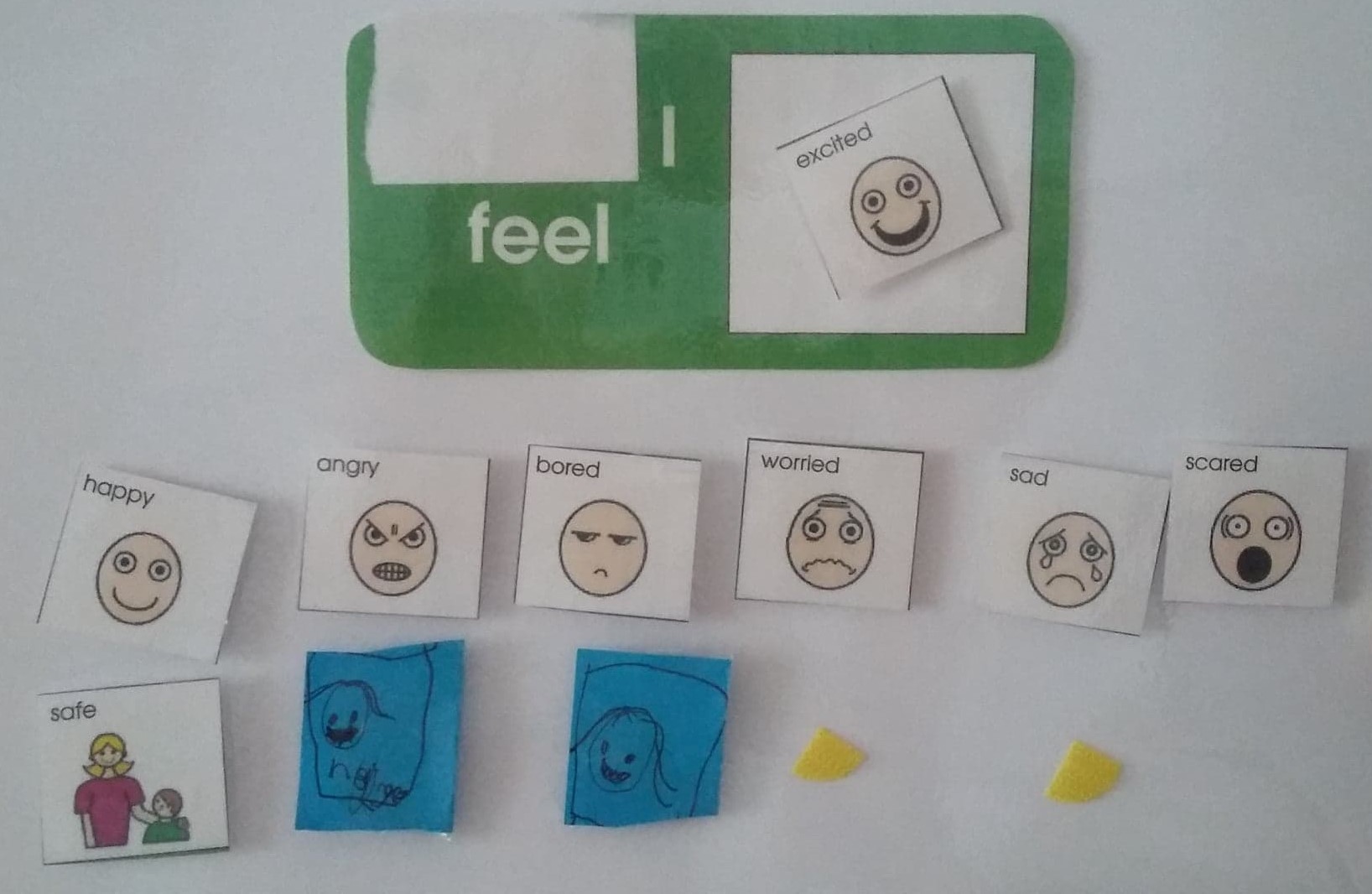
♥Visuals to support communication when things go awry. Sometimes having that 1-1 chat can be too overwhelming for some learners as well as relying heavily on the spoken word. Using visuals like this can seem less intimidating and more collaborative, provides a structure to the conversation and makes the spoken word both visual and permanent which supports language processing and working memory.


I quickly pulled this together to help a child communicate his opinion on how information about his autism should be delivered to his class. His mum had previously told me if folks use words alone, he is not able to communicate his opinion.

This particular (very bright) P7 boy found it impossible to use words to communicate whether he needed help or not. This worked like a dream as all he had to do was place a piece of blu tac on the appropriate wording as he worked through his plan …

This is a combination of a 5 point scale and talking mats I used to help gauge how different things made this child feel.

Use visuals to help children and young people communicate feelings/emotions. These are some examples I’ve either used myself or have downloaded from elsewhere. Sometimes a child needs to see a visual once and they have the framework or ‘script’ in their head forever. Other children need to see the visual regularly, or have several copies in different places, or a folded copy in their pocket or may need to have its use modelled to them by an adult. Don’t assume that because a child is highly verbal they don’t need visuals.


Some more ideas to give autistic children/young people a voice:


♥NLC communication Friendly have some fabby visuals to support the learner to have a voice.


It’s a good idea to teach children how to use speech and thought bubbles to communicate. Have a ready supply in your class or at home and teach them how to use them.

3 How we can adapt our communication to support understanding?
♥This article includes advice from the National Autistic Society on how we can adapt our communication when interacting with autistic children and young people.

From The Hanen Centre – the four ‘S’s to help you remember how to adapt your language to make it easier for autistic (all?) learners understand the spoken word.
Say less – reduce your language. Say what you mean and mean what you say.
Stress – stress the key words which convey meaning.
Go slow – slow down your rate of delivery. Pause between sentences. Count to 6 in your head.
Show – where possible, use visuals to support your language (gesture, objects, pictures, photographs … )

2 Autism and motivation
(Click on image to enlarge)

3 Thinking styles
♥Great article from Embrace Autism. 10 min. read.

♥A visual approach is always helpful for those with different thinking and processing styles. Some examples from Communication Friendly.


