
In this section:
1 What we mean by ‘sensory differences’. Information on our 8 sensory systems – what they are and how they are impacted in autistic people
2 What is stimming?
3 Videos demonstrating what it might feel like to experience sensory overload
4 Sensory checklists to download
5 What is a ‘sensory diet’?
6 Don’t know what the learner’s sensory differences are?
A ♥ indicates images that follow are hyperlinked
1 What do we mean by sensory differences?
NB Sensory differences are not particular to autism.
According to the research organisation Autistica, 9/10 autistic people have difficulty processing everyday sensory information. It should be noted that sensory differences are not particular to autism. Any of the senses may be over (hyper) or under (hypo) sensitive (or both) at different times. We are beginning to understand the significant impact sensory differences have on many autistic peoples’ ability to function day to day.
Dr. Tony Atwood, who has been working in the field of autism for almost 40 years, informs us ‘Some adults … consider their sensory sensitivity has a greater impact on their daily lives than problems with making friends, managing emotions and finding appropriate employment’. These sensory differences can affect behaviour and can have a profound effect on a person’s life. If not addressed, sensory differences can result in meltdowns or shutdowns.
Introducing a ‘sensory diet’ (see below) may be a way of reducing a child/young person’s anxiety and can help reduce or even prevent meltdowns/shutdowns.
What do the key documents say?

P5 ‘For all aspects of learning, consideration should be given to each learner’s sensory profile’.

P5 ‘ Consideration is given to each child’s sensory preferences.’
P14 ‘Working within an inclusive classroom … some learners may require the use of agreed sensory supports.’


♥… and includes a helpful video from an OT.

As outlined in the video above, we all possess 8 sensory systems.
-
Visual system (sight) – responsible for seeing.
-
Gustatory system (taste) – responsible for our sense of taste.
-
Olfactory system (smell) – responsible for processing smell.
-
Tactile system (touch) – processes touch information from the body.
-
Auditory system (hearing) – responsible for hearing.
-
Vestibular (balance) – helps us to maintain balance and posture and understand where and how fast our body is moving.
-
Proprioception (body awareness) – helps us know where our body is in space and how different body parts are moving in relation to each other. It’s the reason you can switch your alarm clock off without looking!
-
♥Interoception – tells us what’s happening inside our bodies (hot, cold, thirsty, need the loo, feeling happy, sad, angry). This 12 minute video explains more about interoception. It’s fascinating!

♥A 2 minute video explaining interoception.

♥Great short article on sensory processing differences.

♥A booklet produced by Falkirk Council for parents/carers but equally useful for schools. I’ve recommended it to so many people over the years.

♥Great website from Glasgow City Council which includes a short videos explaining sensory differences and an online tool to help work out what a learner’s sensory needs are and how to address them. Developed for parents but very helpful for practitioners too.

This was posted on Facebook by the mum of a child I once worked with. He had a meltdown because this little piece of fluff was in his sock. His tactile system is hyper sensitive and, to him, it was unbearably painful.

♥I LOVE Neurodivergent Lou’s Facebook page. Here’s what they have to say about sensory differences:


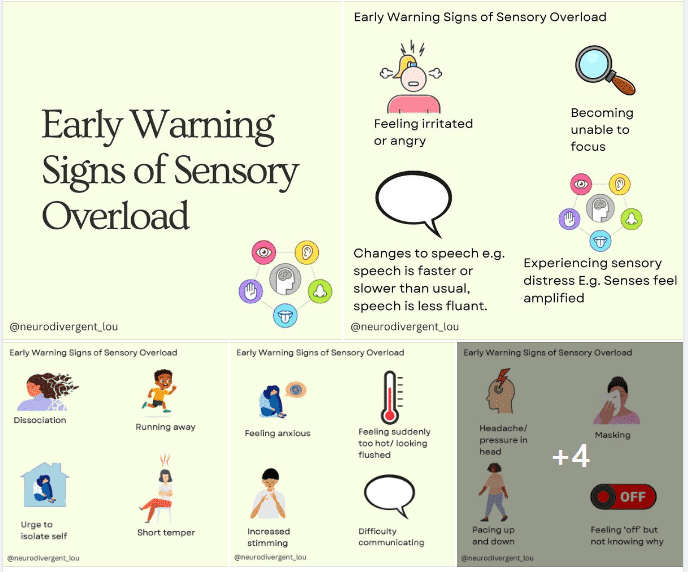
Autistic people say … ‘no, we won’t ;just get used to it’. It hurts!’.

2 What is stimming
♥ Short article from NAS.

3 Videos demonstrating what it might feel like to experience sensory overload
The following videos help us understand what sensory processing differences/sensory overload/too much information can feel like. As you view the videos please keep in mind – they are not fantasy. They are likely the everyday reality for the autistic learner you are working with.
♥This 3 min. video with Dr. Xander explains sensory differences so clearly.

♥This 3min. 15sec. YouTube video was made by an autistic teenager to help others understand what sensory differences feel like. It’s simply a walk down the street. After viewing, reflect on what those sensory differences might feel like if the film were made in a classroom, the playground, a school corridor, shops, a party etc.

♥Scottish Autism produced this video (less than 2 mins.) to help explain sensory differences.

♥A video illustrating what it can feel like to be autistic.

♥… and some more info about the making of the above video.

3 Sensory checklist to download
Sensory checklists, completed with parents, can help you identify what a child’s sensory differences are. Sometimes when you understand what the sensory differences are it is obvious how to support them, how to adapt the environment or which activities to try. For example, if they are over sensitive to light, reduce fluorescent lighting and perhaps use dimmer switches or lamps, adjust blinds etc. I have used both of these checklists in the past and found them helpful in helping work out what a learner’s sensory differences are.
♥From Autism Understanding Scotland (‘Downloadable Documents’ are hyperlinked below):

♥

♥

♥

4 What is a ‘sensory diet’?
If you can, enlist the help of Occupational Therapy. They are the experts on sensory differences and can often carry out a sensory assessment then offer strategies. Here’s a mum’s advice to other mums on Facebook about a sensory diet recommended for her child after working with OT …

♥… and some info on sensory diets.
When you have an understanding of the learner’s sensory differences, you can begin to introduce a ‘sensory diet’ (i.e. some activities and/or adaptations during the day) as it can be a way of reducing a learner’s anxiety and reducing or even preventing meltdowns/shutdowns. This short video explains what we mean by a ‘sensory diet’.

♥Sensory Circuits are such a great way of helping learners remain calm/stay regulated/get rid of energy etc. This short video explains how to do it. Add it to their daily routine. You draw the first one then learners could add their own favourite activities. Could kids design circuits for each other? Also teaches number skills, literacy skills, sequencing skills, concentration… Words could be replaced with pictures. You’ll come up with so many more ideas I’m sure.

♥Advice from NAIT on providing a sensory diet – they call it ‘movement breaks’.

♥Some ideas of reasonable adjustments schools can make for autistic pupils’ sensory differences.

5 Don’t know what a learner’s sensory differences are?
Occupational Therapists tell us that if you are not sure what a child’s sensory differences are, ‘heavy work’ activities can be effective in calming our sensory systems. Here are activities that can easily be introduced into school. They may even be part of a child’s daily timetable or may be activities they carry out in their quiet space or as part of their ‘jobs’ in school.
♥Some advice and a free downloadable A4 visual. Explains what we mean by heavy work and gives some examples of activities for home and school.

♥Another free printable which also includes a short video explaining what ‘heavy work’ is.


♥Some ideas for parents to try at home.

♥Ever thought of introducing sensory boxes?

Just LOVE this idea. Probably against all health and safety rules!

A neurodivergent adult I know (a promoted teacher) attending a 2 hour online training from their desk at work whilst simultaneously preparing a newsletter. They made their own adjustments – headphones on, comfy ‘nest’ under desk (fashioned from their winter coat) – in order to get the tasks of the day completed successfully. I can guarantee you they will have been completed to a very high standard!
