NB Most images are hyperlinked
and will either take you to a website or will enlarge the image to allow you to read more easily.
Sometimes images remain invisible (I know not why!). If you think there should be an image, click where you think it should be and it will likely take you to the hyperlink.
In this section:
1 Resources to help you better understand autism
2 Neurodiversity – what is it?
3 The autistic voice – links to videos and articles by autistic people explaining what it’s like to be autistic
4 The link between autism and and anxiety and how this can lead to masking, shutdowns and meltdowns
5 Information about Pathological Demand Avoidance
6 Autism and girls
7 Stimming
8 Anxiety related absence (School refusal)
1 Resources to help you better understand autism
What is autism?

Information on those ‘thinking differences’ from the National Autism Implementation Team (NAIT)
Sopport for our autistic learners should always be anticipatory. We should expect that they will have challenges in the highly social and sensory environment that is a school. This article from ‘Teaching Scotland’ (Page 18) explains in more detail.

These are the resources which will give you up-to-date, reliable, evidence-based information about autism.
Information, advice and research from The National Autism Implementation Team. The NAIT Team are professionals from Education, Speech and Language Therapy, Occupational Therapy and Psychiatry, who have considerable experience and expertise in working with autistic individuals of all ages, their families and others who support them. NAIT provide practitioner to practitioner advice.

… from this website

‘The Autism Toolbox’. A wealth of information and a resource for nursery, primary and secondary schools. Be prepared to get lost for hours!

This 13 minute video by John Simpson about autism and secondary school was made several years ago but still contains relevant information and advice. 14 minute video

Free modules from Education Scotland.

‘Understanding Autism’ is a FREE online course from the University of Kent.

‘Understanding Autism’ from The Open University. Yet another FREE, online series of modules.

From ‘The Art of Autism’ One of the best explanations of autism I’ve come across so far written by an autistic woman.

Some short videos to help everyone (adults, young people and children) understand autism.
From Scottish Autism ‘What is autism?’ 4 minute video.

From the National Autistic Society ‘Do you know somebody with autism?’ 4 minute video.

Really good animation ‘Amazing Things Happen’. 6 minute video.

A ‘Newsround’ clip by Rosie King. This has been around for many years now but it’s still a great watch. 15 minute video.

3 minute video which gives sound advice on how to talk to children/young people about their autism.

Short article from Facebook on shy you should tell your kids they’re autistic.
2 Neurodiversity – what is it?
‘The Neurodiversity Movement has its origins in the Autistic Rights Movement that sprung up in the 1990’s. The term neurodiversity was coined in 1998 by an autistic Australian sociologist named Judy Singer, and was quickly picked up and expanded upon within the autistic activist community.
The focus of work within the neurodiversity paradigm has broadened beyond autism to encompass other forms of neurodivergence, while at the same time the paradigm has increasingly gained footholds in various realms of scholarship, literature and praxis’.
‘Neurodiversity is the diversity of human brains and minds, the infinite variation in neurocognitive functioning within our species. The Neurodiversity Paradigm is an emergent paradigm in which neurodiversity is understood to be a form of human diversity that is subject to the same social dynamics as other forms of diversity (including dynamics of power and oppression)’.
(Excerpts from ‘The Neurodiversity Paradigm’ by Nick Walker)
This illustration explains it simply …

From the Autism Toolbox

3 The autistic voice – links to videos and articles by autistic people explaining what it’s like to be autistic
If you really want to understand autism and learn about the most effective strategies to use, speak to autistic people and ask them to explain their sensory differences, meltdowns, what it’s like to spend a day at school, what it’s like trying to operate in a group etc. It’s fascinating hearing their different perspective of the world. The next best thing is to listen to what autistic people have to say online. Here are links to videos of autistic people I think are brilliant at talking about their autism and helping us ‘neurotypicals’ understand what it’s like to live with autism …
I’ve thought long and hard about including this video as Hannah uses (5 times) language some may find offensive. However, it’s so brilliant at helping us understand autistic thinking I’m going for it! Here’s a little bit of info on Hannah Gadsby:
Growing up, Hannah Gadsby always felt she was different. She struggled to read social cues, she had trouble applying for jobs, and spent a few living in a tent and doing farm labor. But Gadsby, who’s from Tasmania, had always been funny. On a whim, in 2006 she entered a stand-up comedy competition — and won.
“I’d never held a microphone before. … I’d never even been to a comedy show — but all of a sudden, I kind of knew what I was doing,” she says. “As soon as I told my first joke … it really made people engage with me, and I held the audience in my hand.”
Gadsby embarked on a comedy career in Australia, but she still felt out of place. It wasn’t until 2016, when she was diagnosed with autism spectrum disorder that things started to make sense.
“It shifted the way that I understood myself,” Gadsby says of the diagnosis. “I was always operating on the false premise that everyone saw the world like I did.”
“People on the spectrum … sort of feel like an alien being dropped in from outer space, and you can’t quite connect properly,” she says. “Being on stage and making a room full of people laugh, felt like a connection I hadn’t been able to establish in any other environment.”
Enjoy! She is VERY funny! 7 minute video.

Purple Ella is an autistic woman who has made several videos where she describes her own autism. Link takes you to lots of 10/15 minute videos made by Ella.

Dean Beadle is an autistic adult who travels the world talking about his autism to various groups. He is also VERY entertaining! 11 minute video.

Being diagnosed with autism is often seen as a tragedy. But for Jac den Houting, it was the best thing that’s ever happened to them. 13 minute video.

John Simpson is an academic and autistic adult. In this selection of videos, John discusses his experiences of school (positive and negative), the importance of structure/routine/predictability, friendship and communication/social skills, advice for teenagers, advice for parents/carers, anxiety, mental health and self esteem and special interests.

2 minute video clip of Gary Newman talking about his autism.

A 5 minute video from Chris Bonnello (a qualified teacher and tutor of children with additional support needs) talks about his report from nursery.

Sgilti a young autistic person talking about secondary school. Great series of short videos giving us a real insight into what school is like for him.

Some autistic young adults talk about processing speed – it’s crucial non-autistic people understand this stuff!

If you’ve ever wondered why some autistic people have meltdowns, this may answer your question.

4 The link between autism and and anxiety and how this can lead to masking, shutdowns and meltdowns
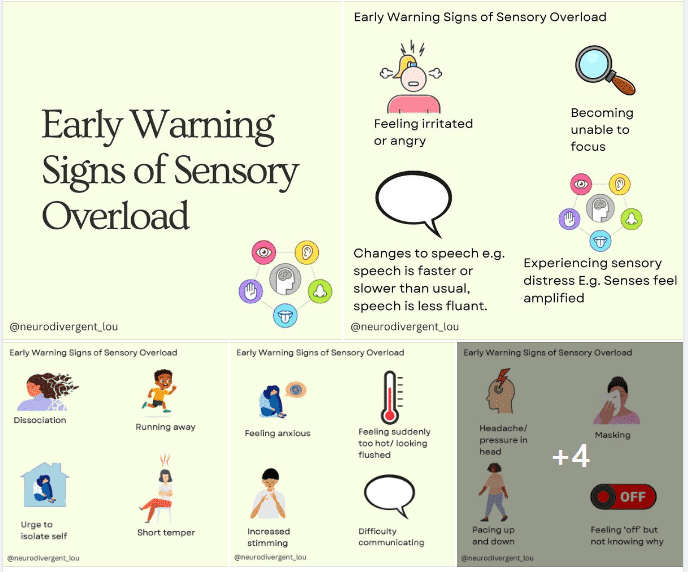
Anxiety is likely to be the overarching emotion experienced by an autistic person. Research informs us that anxiety disorders are substantially more common in autism than in the general population (10 – 15% of the general population and at least 40% of autistic people). They may express their anxiety through behaviour that challenges us. That might look like defiance, avoidance (including school), over planning, difficulty focusing, sore tummies and headaches, difficulty managing emotions etc. which may eventually result in a ‘meltdown’. Or you may see nothing which may be ‘shutdown’.
The child may be masking their autism and/or anxiety in school. Autistic girls are significantly under diagnosed and one of the reasons for this is they are skilled ‘maskers’ (boys mask too!). Masking is exhausting and anxiety provoking for an autistic child or young person meaning they may meltdown/shutdown at home. This situation is difficult for all involved as the child/young person may be ‘holding it together’ in the very environment which is significantly contributing to their anxiety. If this happens to be the case, it’s understandable that staff perceive they are ‘doing fine’ which can be very frustrating for parents/carers.
It cannot be stressed enough that anxiety is reduced in an environment which is highly visual, structured, predictable and ensures sensory differences are addressed. Remember … autism is a communication difficulty so they may not communicate their anxiety either effectively or appropriately.
Understanding that anxiety presents itself in many ways helps to explain behaviour that challenges us (what we are now referring to as distressed behaviour).

This article explains why many autistic children and young people are ‘fine’ in school but meltdown at home.

A MUST read. Autism, anxiety and the impact on parents. Like the author, I hear similar stories almost every day of my working life.

Some more information on anxiety, masking, meltdowns and shutdowns.
Information and advice from the National Autistic Society on autism and anxiety in school.

A great short read from Sarah Henedrickx (an autistic woman, autism consultant and author) about autism and anxiety in the classroom.

Research findings from The Autism Research Group. Easy to read and current, sound advice.

Sarah Hendrickx (an autistic woman, autism consultant and author) talking about how anxiety affects everything. 45 min. video but well worth watching.

Two videos (10 and 15 minutes long) from Purple Ella talking about meltdowns and what to do if you are with an autistic person in meltdown.


A Purple Ella video about shutdowns.

A blog about masking.

A video about masking.

5 Information about Pathological Demand Avoidance
PDA is now more recognised as a distinct profile of autism. Individuals with a PDA/EDA (alternative terminology: Extreme Demand Avoidance) profile will share similar difficulties to others on the autism spectrum (triad and sensory). In addition, the central difficulty for people with PDA is their “anxiety-driven need to be in control and avoid other people’s demands and expectations.” Understanding PDA in Children. Christie, Duncan, Fidler & Healy (2011). It is the Autism which underpins the extreme demand avoidance and need for control. Because PDA is not currently included in either of the diagnostic manuals (DSMV and the ICD11), the validity of this profile of ASD remains a contentious subject among some professionals.
Features of PDA …
- Resisting and avoiding the ordinary demands of life – getting up, joining family meal, even when it’s what the person wants to do.
- Use social strategies as part of the avoidance.
- Compliance on ‘their terms’.
- Appearing sociable on the surface.
- Excessive mood swings and impulsivity.
- Lack of constraint by social norms or sense of hierarchy.
- Comfortable in role play – reality and pretence merge and blur.
- Threats or extreme behaviour.
- Lack of sense of responsibility or sensitivity to others’ distress.
- Failure to constrain behaviour in public.
- Obsessive behaviour – often social in nature.
What this might look like …
- Can be controlling and dominating, especially when anxious and are not in control of their environment.
- Can also be very affectionate, charming, sociable and chatty, when they are calm and feel safe. This conflicting and variable presentation is confusing for parents and professionals alike.
- Sometimes a child with PDA can appear very anxious at home but remain relatively passive at school (masking).
- Demands at school can lead to severe ‘meltdown’.
- Some children can experience such high anxiety in school that they become school refusers.
- Just as with ASD -> experience over or under-sensitivity in any, or all, of their senses: sight, smell, taste, touch, hearing, vestibular, proprioception or interoception.
- Seen in people of both genders and in equal proportions. No prevalence rates for PDA yet. As more diagnoses of PDA are made, prevalence figures will become more apparent.
A half hour podcast for parents but very useful for professionals t00.

The most reliable and evidence based information is to be found on the PDA website.

PDA information from the National Autistic Society.

10 minute video by a mum of a girl with PDA. Pathological Demand Avoidance (PDA): Characteristics and Strategies.

Information and Advice from two inspirational practitioners. In this PDA Society webinar Phil Christie and Ruth Fidler from Autism Associates provide an overview of the education and support needs of children with the PDA profile. They outline how some of the strategies that are typically found to be effective for autistic children and young people (such as the use of routine, predictability and structure) need considerable adaptation, as PDA individuals respond better to less direct and more collaborative approaches.

An 8 minute video which gives real life insight into PDA.

Purple Ella talks about demand avoidance.

Some starting points for school staff:
- Quality of relationship is key. The opposite of anxiety isn’t calm … it’s trust.
- Identify a quiet space (with child/young person if appropriate).
- Show respect – kids should know you like them unconditionally.
- Build in flexibility and choices to timetables – sense of autonomy. Balance – 2 options – offer to whole class?
- Think ahead/plan for change. Give child advanced warning.
- Work with special interests. Their special interest is your most valuable tool.
- Keep calm! PDA kids are adept at reading reactions -> your reaction may motivate!
- Be willing to apologise. No relationship – no progress.
- As few ground rules as possible – pass over responsibility ‘I’m sorry it’s health and safety’ or ‘It’s on the timetable I’m afraid’.
- Use complex language? Can sound more negotiative and may intrigue.
- Humour can help.
- Monitor stress levels – scale back demands if necessary.
- Indirect language. ‘I wonder if we can …?’ ‘Maybe we could investigate …?’ etc.
- Use distraction.
- Ask for advice!
An adult writing about her PDA.

6 Autism and girls
- Previously thought fewer females on the spectrum.
- It is now recognised from research, clinical practice and anecdotal reports that many autistic females are not being recognised. This can result in misdiagnosis, late diagnosis, or women and girls not being diagnosed at all.
- Some say the diagnostic criteria for autism are biased towards the behaviour of men and boys. ’Diagnostic tools … were developed according to male phenotypes’ (Gould and Ashton-Smith, 2011). Whatever the reasons, we know that autistic women and girls are still hugely misunderstood.
- More subtle presentation -> barrier to clinicians and other professionals.
- It’s still more common for men and boys to receive a diagnosis of autism. Increasingly believed autistic women and girls may be better at masking their difficulties -> autism missed.
- It seems that girls on the autism spectrum may be less noticeable than boys because they are less disruptive and have an ability to mimic behaviours (Attwood, 2012).
The general consensus is that females with ASD exhibit:
- Increased social imitation skills
- A desire to interact directly with others
- A tendency to be shy or passive
- Better imagination
- Better linguistic abilities developmentally
- Interests that focus on animals or people
- Masking!
From ‘Right Click’, an online resource from Scottish Autism.

A 20 minute interview with Dr. Judith Gould from the National Autistic Society 2015 Women and Girls conference. Still relevant today.

An online module from the National Autistic Society. Great resource. Cost £30

7 Stimming
Information from the National Autistic Society

A visual from NLC Communication Friendly

8 Anxiety Related Absence (School refusal)
Advice for school staff from The National Autism Implementation Team for those autistic learners who are experiencing anxiety related absence and are unable to return to school.