
In this section:
1 How to create structure, routine and predictability in the physical environment
2 Visuals – Calendars, visual timetables, visual schedules
3 Quiet space – why and how?
4 Teaching children/young people about their social energy – why and how?
5 Class seating
6 Workstations – what, why and how?
7 Differentiation hints and tips
A ♥ indicates images that follow are hyperlinked
1 How to create structure, routine and predictability in the physical environment
What do the key documents say?

P4 ‘Environment first. The physical … environment should be appropriately adapted to meet the needs of all learners. The physical environment includes the way the school looks and feels and how learners use materials and move around. Noisy and busy parts of the school (e.g. dining hall and gym) are often stressful environments for autistic learners’.

P3 ‘In an inclusive setting, the physical … environment is appropriately adapted to meet the needs of all learners. A predictable environment that supports independence and participation for autistic learners is likely to include:
-
an individualised visual timetable relevant to developmental stage
-
other visual supports
-
an individualised safe space (that they chose to go to)
-
planned movement breaks
P5 ‘The physical environment refers to the physical layout of the classroom and the resources used within it.
P10 ‘ All learners are influenced by the physical environment. … supports focus on “tuning” the physical … environment; establishing structures and routines throughout the school day.


and

I like this summary from ‘Total Spectrum’.
‘Routine is a good thing. Research informs us that we could all benefit from having a routine and a regular rhythm in our lives. But routine is especially important for children with autism. Here are some of the reasons why:
-
Order From Chaos. Many children and young people with autism live in a world of chaos. They have difficulty making sense of everyday movements, sounds, and actions. What sounds like a symphony to you may sound like white noise to the ASD child. Routine creates order in their lives. These children and young people gradually learn what to expect and when to expect it. Routine creates a safe and secure environment in which life is predictable.
-
Routine Comes Naturally. Children and young people with autism naturally tend to like repetitive actions. You often will notice them creating repetition themselves. Routine comes naturally to them.
-
Stress Relief. Routine is known to relieve stress is almost all individuals. The child or young person with autism has a particularly stressful life as he or she tries to make sense of his or her surroundings. Adding routine will relieve the their stress.
-
Routine Adds to the Learning Potential. Once you can relieve the child’s/young person’s stress, then it’s much easier to help the child learn new things. New habits. New skills. New accomplishments. Routine is a powerful learning tool in the ASD environment‘.
Visuals/visual timetables/visual schedules/social stories should be used to prepare autistic people, young and old, for today, tomorrow, the future, change, events, holidays, dentist … don’t assume they know what is going to happen in their day. Autistic people need to see what is happening. They must be prepared for changes and transitions. No surprises! It reduces their anxiety making it much more likely they can cope with the day ahead.
Came across this from the Autism Education Trust (English law). A quick checklist is always a handy thing to have around.

♥I find this summary of reasonable adjustments from Autism Understanding Scotland helpful. This charity did not have it’s funding renewed which is a great pity as it was completely autistic led and carried out some fab work. They have kept their Information Hub ‘live’ so folk can still access advice. Here’s what they say about environmental adjustments:
(text is a bit small – click on each of the 2 images to enlarge)

Before you think about anything else, think about lighting. Fluorescent lighting of any kind can be unbelievable dysregulating for lots of learners. Which of these 2 environments would you find it easier to work in? (slide from one of my presentations).

2 Visuals – Calendars, visual timetables, visual schedules
Visuals are anything you can see. Something that helps back up the spoken word and makes it permanent. This slide from a presentation of mine helps us understand what we mean by visuals.


Important to remember!

♥There’s a kind of hierarchy to introducing visuals, depending on the age and stage of the learner. Have a read at this article.

Do learners have access to a calendar/timetable (home and school) so they know what’s happening when and with whom?
Are they OK with the class timetable or would they prefer their own individual copy too?
Be aware that there are some autistic people who become more stressed by timetables and calendars (PDAers?). If in doubt, ask them.
If I were back running my own classroom I’d have a class timetable as well as weekly and monthly calendars on display that I would refer to regularly. I’d use them to show any changes that were happening that day and in the future. I would offer individual timetables to not just the autistic learners but to all learners. Why do we wait until learners are in secondary school before we give them their own timetable?
♥Here’s a great article from Lynn McCann at Reachout ASC entitled ‘The right way to use visual timetables’. She explains that allowing learners to access timetables teaches them so much more than what is coming next.

This timetable was written for a 5 year old … text (cursive!) worked for him rather than images. He loved adding a smiley face when an activity was completed.

A couple of example to illustrate that timetables don’t always need to be ‘hi tech’! What’s far more important is that the learner is involved pulling it together.


It’s so easy to quickly understand this was a Friday morning, the child was in room 2 with Miss Di Nardo, PE was first followed by 2 more activities before playtime.

Timetables using real objects can be created for non-speaking learners or those who are developmentally delayed. Here’s an example. Moving from left to right, the learner removes the object from the polypocket (which helps them identify the task), finds the matching task. When the task is complete, the object is placed in the finished (blue in the image) basket and the learner moves on to the second object.

♥Downloadable visuals from The Autism Toolbox – lower and upper primaries.


For some learners who are not yet able to cope with a full day’s timetable, a ‘first/then’ or ‘now/next’ approach is the answer. Here are some examples. what you can’t see in the photo below is the ‘finished’ basket.

Depending on their developmental stage, an object, a photograph, a line drawing, text etc. can be placed in each section.


They don’t have to be shiny and laminated. This looks more like the visuals I’ve used over the years.

Do they need an individual ‘checklist’ to help them complete tasks? Could this be offered to all learners? Some examples.


3 Quiet space – why and how?
♥Autistic children, young people and adults need regular time on their own away from the highly social (and stressful) environment that is a school (or workplace) to de-stress and re-charge their ‘social battery’. Have you identified a quiet space with them (home and school)? Would they benefit from regular times in their quiet space built into their timetable/day? This is necessary even if they really want to be with other people. This video explains why. It talks about ‘Asperger’s’ and ‘high-functioning teens’ but it applies to ALL autistic people.

An oldie now but still a goodie!
Patricia Howlin (1998, p200), Professor of Clinical Child Psychology, notes that when it comes to challenging behaviour ‘letting children spend time/play games alone in the library or carrying out other tasks and providing them with a set space to sit may have a much greater impact than a complex behavioural programme’.
♥Advice from NAIT on safe spaces. I had a quick chat with them about the use of the word ‘safe’. I feel if we call it a safe space it implies everywhere is unsafe. Folks agreed it’s difficult to get the right word so I think we call it whatever the learner wishes to call it. I’ve had ‘quiet spot’, ‘concentrations spot’, ‘chill out zone’ etc. Having said all that, many, many autistic people will say they did (or do) feel unsafe in a school environment.

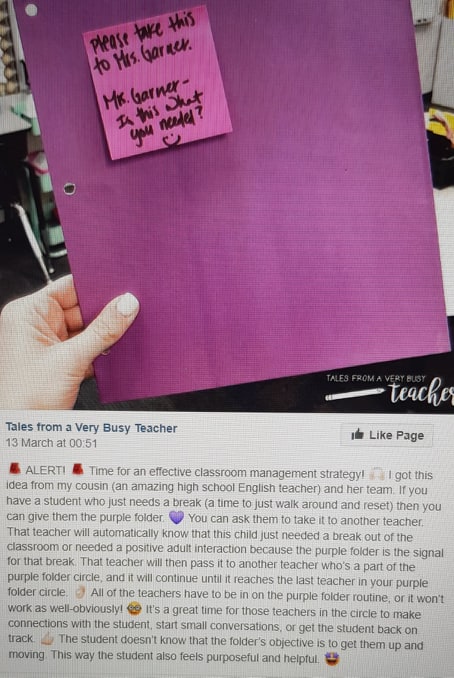
Some young people don’t want to appear (although they will certainly feel) different to their peers so allowing them access to an individual safe space is not appropriate. Here are some ideas of how to give them those breaks out of class in a covert way. Disguised as the ‘purple folder’ from a Facebook post.
the rucksack
the paperclip code
5 Class seating
Sometimes a whole desk to themselves at the end of a group can be of huge benefit.


6 Workstations – what, why and how?
♥Would they benefit from access to a workstation (concentration spot, office)? This should NOT be used as a punishment and the child/young person should also have their own place in a social group. Should be seen as a positive place to be. Workstations can be adapted for any age/stage. Here’s a link that explains how to set up a workstation.

♥Love this explanation from Chalkboard Superhero.

♥Sign up for Chalkboard Superhero’s Starter pack and other freebies!

Here are some examples of workstations.


♥This short video explains how to structure a workstation. This is only one way of doing it!

♥Another video illustrating how a workstation should operate.

♥This video explains to children how to use their work system.

7 Differentiation hints and tips
Apologies if you feel this section is a bit like teaching a granny to suck eggs!
‘Is the curriculum sufficiently differentiated? Although the child might seem to cope with the majority of normally differentiated work, there will be times when more individual differentiation is required. It is appreciated that this can be difficult to plan and organise but in order for the child to be included successfully, reduce inappropriate behaviour and reach their potential, changes may be needed.’
It’s important to remember that autistic children and young people are having to cope with a ‘double curriculum’ all day, every day. This is illustrated brilliantly in a slide from a talk given by Dr. Peter Vermeulen.

♥Good advice on differentiation for primary and secondary schools from Leicestershire Council.

General advice for secondary teachers from Lynn McCann at Reachout ASC. Also relevant for primary.

Lynn McCann at Reachout ASC wrote this piece for the National Autistic Society – more advice for secondary teachers.
